
Credential Lifecycle
Overview
Section titled “Overview”TCS is more than a credential issuance API — it is a trust anchor and governance layer for verifiable credentials. Protocols like OID4VCI define how to issue credentials, but they do not answer who certifies the format, who defines the schema, or who maintains the trust list. TCS answers all three through its Trust Registry and Schema Registry, which act as governance gates across the entire lifecycle.
A credential in TCS passes through six stages: Register, Define, Issue, Hold, Verify, and Govern. This is a continuous cycle, not a linear pipeline. Governance decisions — trust list updates, schema revisions, issuer revocation — feed back into earlier stages and trigger new cycles.
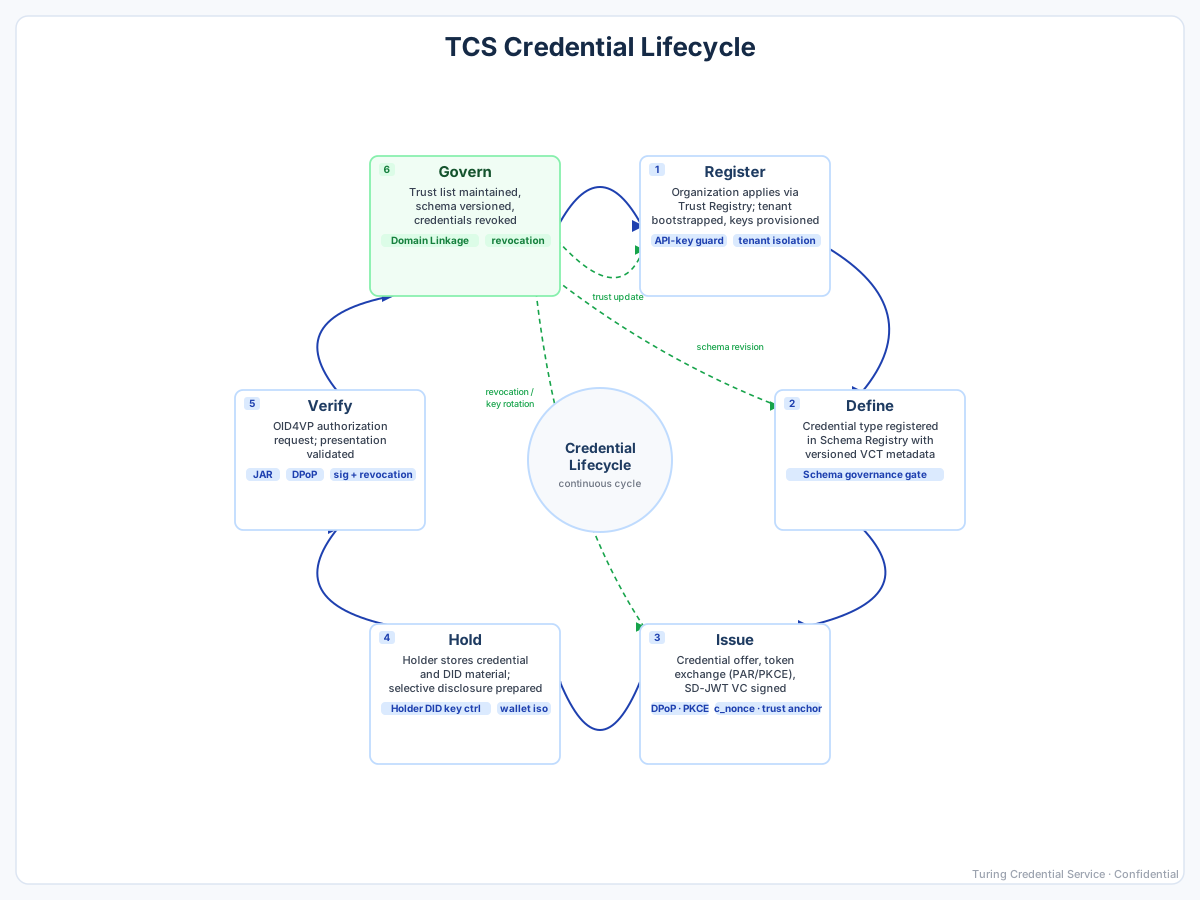
Stage 1: Register
Section titled “Stage 1: Register”Before issuing credentials, an organization registers with the Trust Registry. This lists the organization as a participant and scopes all subsequent operations to a tenant.
During registration:
- A tenant is bootstrapped in TCS with isolated configuration
- The tenant’s credential configurations are provisioned from the registered schemas
- An API key is returned once, for authenticating with TCS services
- The organization then creates or imports a DID as its digital identity
Why this matters: Every credential traces back to a registered tenant. Anonymous issuance is not possible.
Security controls: API-key guard, tenant isolation.
Stage 2: Define
Section titled “Stage 2: Define”Before any credential can be issued, its type must be registered in the Schema Registry. This creates a versioned, machine-readable contract that describes the credential’s structure and claims.
During definition:
- The credential type is registered with a VCT (Verifiable Credential Type) metadata entry
- Claims, display properties, and version history are declared
- The schema becomes discoverable by issuers, verifiers, and wallets via API
Why this matters: Issuance is gated — the Credential Issuer rejects any offer that references an unregistered or deprecated schema. This enforces governance at the format layer, not just the transport layer.
Security controls: Schema governance gate.
Stage 3: Issue
Section titled “Stage 3: Issue”With a registered tenant and a defined credential type, the organization creates a credential offer containing the claims it wants to certify. TCS signs and delivers the credential using the OID4VCI protocol.
The flow (pre-authorized code, the production path):
- The organization’s backend creates a credential offer via the TCS API
- The offer is delivered to the holder (via QR code, deep link, or push notification)
- The holder’s wallet exchanges the embedded pre-authorized code at the Authorization Server’s
/v1/tokenendpoint for an access token — no PAR, no PKCE, no interactive login - The wallet requests the signed SD-JWT VC from the Credential Issuer’s
/credentialendpoint with the access token + a proof JWT
The result is a cryptographically signed credential bound to the holder’s DID.
The interactive authorization code flow (PAR + PKCE + hosted login) is on the roadmap; it is not the path used by the production pre-authorized flow above.
Security controls: DPoP token binding (HAIP path), c_nonce proof freshness, signing trust anchor (EdDSA or X.509).
Stage 4: Hold
Section titled “Stage 4: Hold”The holder stores the credential in their wallet.
- In non-custodial mode, the credential lives in the holder’s own wallet. TCS does not retain a copy.
- In custodial mode (with Holder Service), TCS stores the credential on behalf of the holder with wallet-level access controls.
The holder can:
- View all claims in the credential
- Choose which claims to disclose in any given presentation (selective disclosure)
- Present the credential to any number of verifiers
- Delete the credential at any time
Security controls: Holder DID key control, per-tenant wallet isolation.
Stage 5: Verify
Section titled “Stage 5: Verify”When a verifier needs to confirm a claim, it creates an OID4VP authorization request specifying which credential type and claims it requires. The holder’s wallet responds with a presentation containing only the disclosed claims.
The verifier checks:
- Is the credential signature valid? (Authenticity)
- Has the credential been tampered with? (Integrity)
- Is the issuer in the Trust Registry? (Trust)
- Has the credential been revoked? (Status)
- Is the presenter the rightful holder? (Binding)
Signature, integrity and binding checks all happen locally using public key material. Where a verifier also checks revocation status, a credential carrying a status reference adds one fetch of its published Status List Token — which covers every credential in that list, so the issuer learns that someone checked the list, never which credential was presented.
Security controls: JAR signed request object, DPoP on presentation, signature and revocation checks.
Stage 6: Govern
Section titled “Stage 6: Govern”Governance is not a final step — it operates continuously alongside all other stages. The Trust Registry and Schema Registry are active governance surfaces that can modify the rules under which credentials are issued and accepted.
Governance actions include:
- Updating the trust list (adding or revoking issuers and verifiers)
- Publishing new schema versions or deprecating old ones
- Revoking or suspending individual credentials, published as an IETF Token Status List the issuer re-signs on every change
- Maintaining Domain Linkage to bind DID identities to issuer domains
When a governance action occurs, it can trigger a new cycle: a revoked issuer must re-register, an updated schema may require re-issuance, and verifiers must update their policies to reflect the new trust state.
Security controls: Domain Linkage verification, revocation list enforcement.
The complete flow
Section titled “The complete flow”What’s next
Section titled “What’s next”- Trust and Governance — How the Trust Registry and Schema Registry establish and maintain trust
- Quick Start — Issue your first credential in 5 minutes